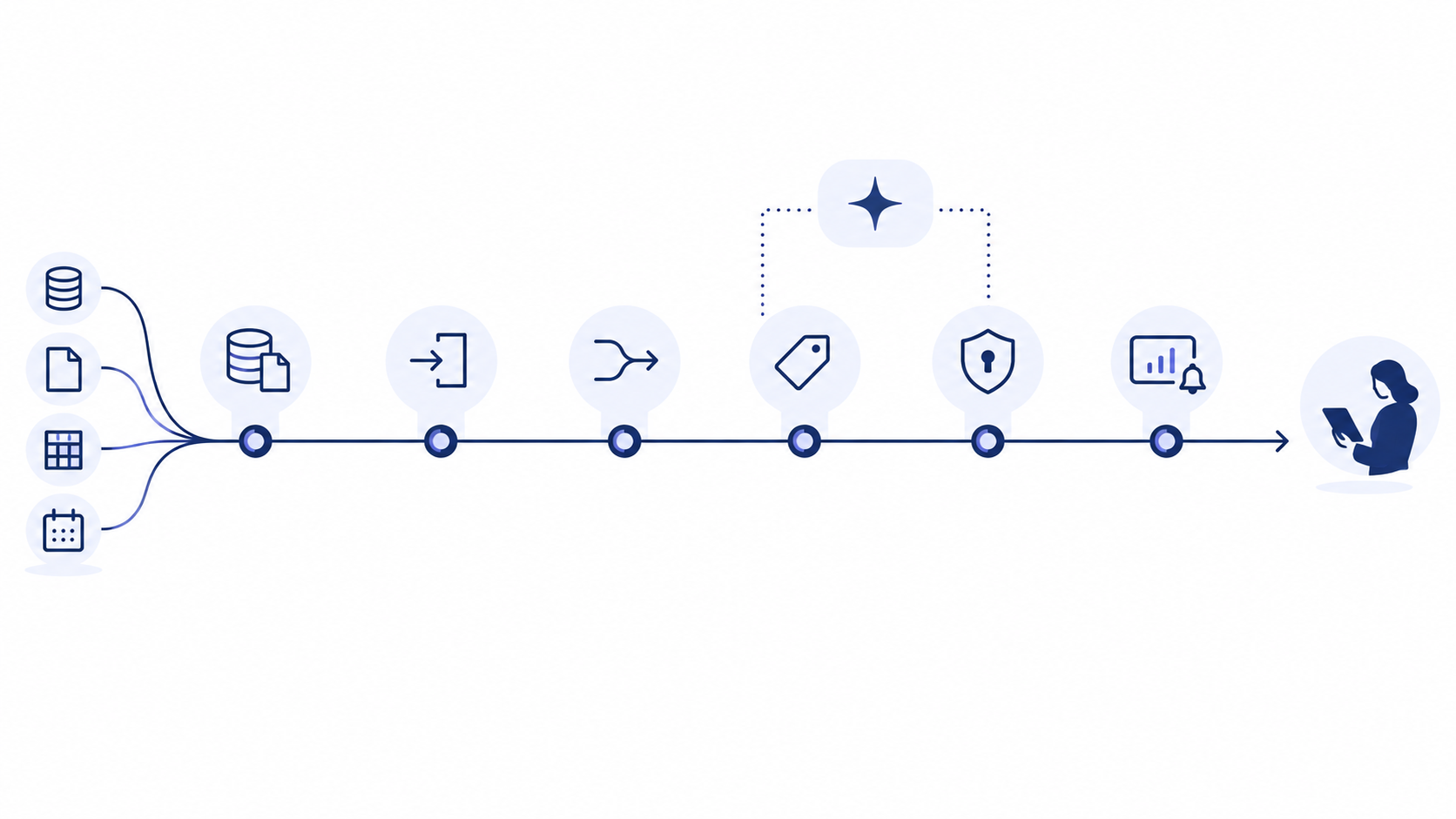
Your organization may already have valuable operational data, but if it sits across disconnected systems, it cannot reliably support dashboards, customer reporting, or AI-driven service. That creates delays, manual checks, inconsistent numbers, and missed opportunities to add value for your own team and your customers. Impacture solves that by turning fragmented back-end data into a secure, scalable layer for insight, automation, and AI — effectively giving you a 24x7 data analyst and AI agent as part of your product or service.
Most organizations do not need another dashboard tool first. They need a reliable way to centralize, standardize, optimize, automate, and visualize their data so insight can be shared in a secure, scalable, and repeatable way with employees, partners, and customers. That is what Impacture delivers.
This page explains how Impacture does that, what business value the model creates, how CentreBlock uses it in practice, and how we take customers from fragmented data to always-on reporting, delivered dashboards, and practical AI.
What Impacture is (and what it is not)
Impacture is an end-to-end platform and managed service that turns fragmented back-end data into validated, secured, and directly usable insight for both Business Intelligence (BI) and Artificial Intelligence (AI). It brings together the functions that organizations often try to piece together across integration tooling, data storage, dashboards, chatbot experiments, and manual reporting — and turns them into one scalable service that delivers outcomes, not just plumbing.
The core proposition
Many software vendors in the service sector face the same problem: their application contains valuable operational data, but that data is locked in. Customers ask for dashboards, predictions, and automation, but the back-end is not set up for it.
Impacture solves this by turning fragmented back-end data into always-on reporting, customer-ready insight, and practical AI. That means operational data becomes connected, structured, secured, and reusable — so it can support dashboards, reports, chatbots, and agentic workflows without constant manual work or one-off fixes.
The resulting environment becomes an extension of your software or service. Your customers experience dashboards, reports, and AI as part of your product, while Impacture manages the infrastructure, governance, connector logic, and ongoing improvement underneath.
Measurable results: CentreBlock as reference
CentreBlock, a software vendor in the service sector, shows what this looks like in practice. With Impacture in place, the platform no longer functions only as back-end infrastructure; it becomes an always-on reporting, dashboard, and insight layer for CentreBlock and its customers.
Reporting time reduced from days to minutes. Where manual exports and spreadsheet processing previously took days, the platform now delivers automated reports that are immediately available to end-customers.
One validated data source for all analytics. Contradictory figures between departments or reports have disappeared. Every user works from the same gold-layer data.
Fast onboarding of new customers. New customers can be onboarded to dashboards and AI functionality quickly, without CentreBlock having to set up a separate environment each time. Each audience only sees the data and insight that are relevant to them.
AI-ready structured data. Because the data is already cleaned, validated, and governed, it can be used much more quickly and reliably for AI applications such as chatbots, copilots, and agentic workflows.
Customer-facing analytics as a product feature. CentreBlock can offer dashboards and insights as part of its own software product, helping turn data into visible customer value.
How Impacture creates value: the 6-pillar model
Impacture creates value through six connected pillars that together centralize, standardize, optimize, automate, visualize, and securely share insight. Instead of treating ingestion, governance, analytics, AI, and distribution as separate projects, Impacture connects them into one commercial model that can deliver value to employees, partners, and customers through the Impacture Sharing Engine.
Pillar 1: Bring data together (Foundation)
This pillar brings data together. It centralizes data from spreadsheets, operational software, SQL environments, APIs, and other connectors into the Ingestion Lake, then standardizes and optimizes it in the Transformation Lake. Because it runs on Microsoft Fabric, the same architecture can start with small practical use cases and scale all the way to some of the largest data environments in the world.
Pillar 2: Make it safe and trustworthy (Data Governance)
This pillar makes data safe and trustworthy. It governs who can see what, applies data-quality rules, and enforces Row-Level Security (RLS) so employees, partners, and customers only see the data that is meant for them.
Pillar 3: Always-on insight (Impact Analytics)
This pillar delivers always-on insight. Validated data is turned into operational dashboards, reports, benchmarks, and customer-facing views that can be distributed through the Impacture Sharing Engine as part of the client experience.
Pillar 4: AI that can actually act (AI & Automation)
This pillar enables AI that can actually act. Instead of working from scattered or unvalidated inputs, AI uses governed gold-layer data to answer questions, support employees, and automate tasks through chatbots, copilots, and agentic workflows.
Pillar 5: Deliver value to your customers (Impacture Sharing Engine)
This pillar puts value in the hands of your customers. Insights, dashboards, reports, and AI output can be delivered through the Impacture Sharing Engine via embedded experiences, APIs, portals, and direct software integrations, in a secure, scalable, and repeatable way.
Pillar 6: Continuous improvement without overhead (Hub / Connected Intelligence)
This pillar provides continuous improvement without extra overhead. It connects the other pillars through monitoring, orchestration, source onboarding, model tuning, and governance updates, so the platform keeps improving as needs evolve.
Connected Intelligence: the bigger picture
Connected intelligence is the principle that data, analytics, and AI do not function as separate projects but as one connected system. The Impacture data platform is the technical translation of that principle: each pillar feeds the next, and the Hub orchestrates the whole.
For service organisations with multiple end-customers, this means you do not run a separate analysis project for each customer. You have one architecture that scales, is secured, and continuously improves. The connected-intelligence approach makes it possible to start with dashboards today and add AI workflows tomorrow, without having to rebuild your foundation.
Key terms (Glossary)
Data Fabric — An architecture approach where data from different sources and formats is made accessible in an integrated way, regardless of where that data physically resides. Impacture uses data-fabric principles to abstract source connections from the analysis layer.
Medallion Architecture — A layered data model with three levels: bronze (raw data), silver (cleaned data), and gold (modelled, validated data). Each layer adds quality and structure. This forms the backbone of every Impacture data platform.
Impacture Sharing Engine — The distribution component that delivers dashboards, reports, and AI output to employees, partners, and customers via embedded integrations, APIs, or portals, with secure access controls built in.
DTAP — Development, Test, Acceptance, Production. An environment structure that ensures changes are tested and validated before they go into production, preventing errors in the data pipeline from reaching end-users.
Row-Level Security (RLS) — A security mechanism that determines at row level which data a user may see. Within Impacture, RLS ensures that each end-customer has access exclusively to their own data.
Retrieval-Augmented Generation (RAG) — A way of making AI answer based on approved company data and documents instead of relying only on general training data. Impacture uses RAG to make chatbot and assistant output more useful, more explainable, and more reliable.
Agentic Workflow — An AI workflow where an autonomous agent independently executes tasks, makes decisions, and triggers actions based on data patterns and predefined rules. Goes beyond passive analysis: the AI acts.
Always-On Insight — The layer within Impacture that turns validated data into dashboards, reports, benchmarks, and customer-facing insight, delivered through the Impacture Sharing Engine.
Impacture gives service-oriented software organisations a secure, managed way to turn fragmented data into always-on reporting, dashboards, automation, and AI for their own teams and their customers.