A report is wrong this month, but nobody gets an error message. No crash, no red flag on a dashboard. Yet one figure deviates from what you expect. This is called data drift (a gradual, silent shift in the meaning or quality of data), and it is exactly why data management is more than storing data. Good data management detects this shift before a decision is based on it.
Data stream monitoring and preventing data drift
Data stream monitoring means you continuously check whether incoming data still matches what you expect, in volume, structure and meaning. Without that check, a definition shifts slowly without anyone noticing.
Data drift often starts small: a supplier changes a product code, a system update changes a notation, or a new employee fills in a field slightly differently. Each change is harmless on its own, but added together a whole report drifts away from reality.
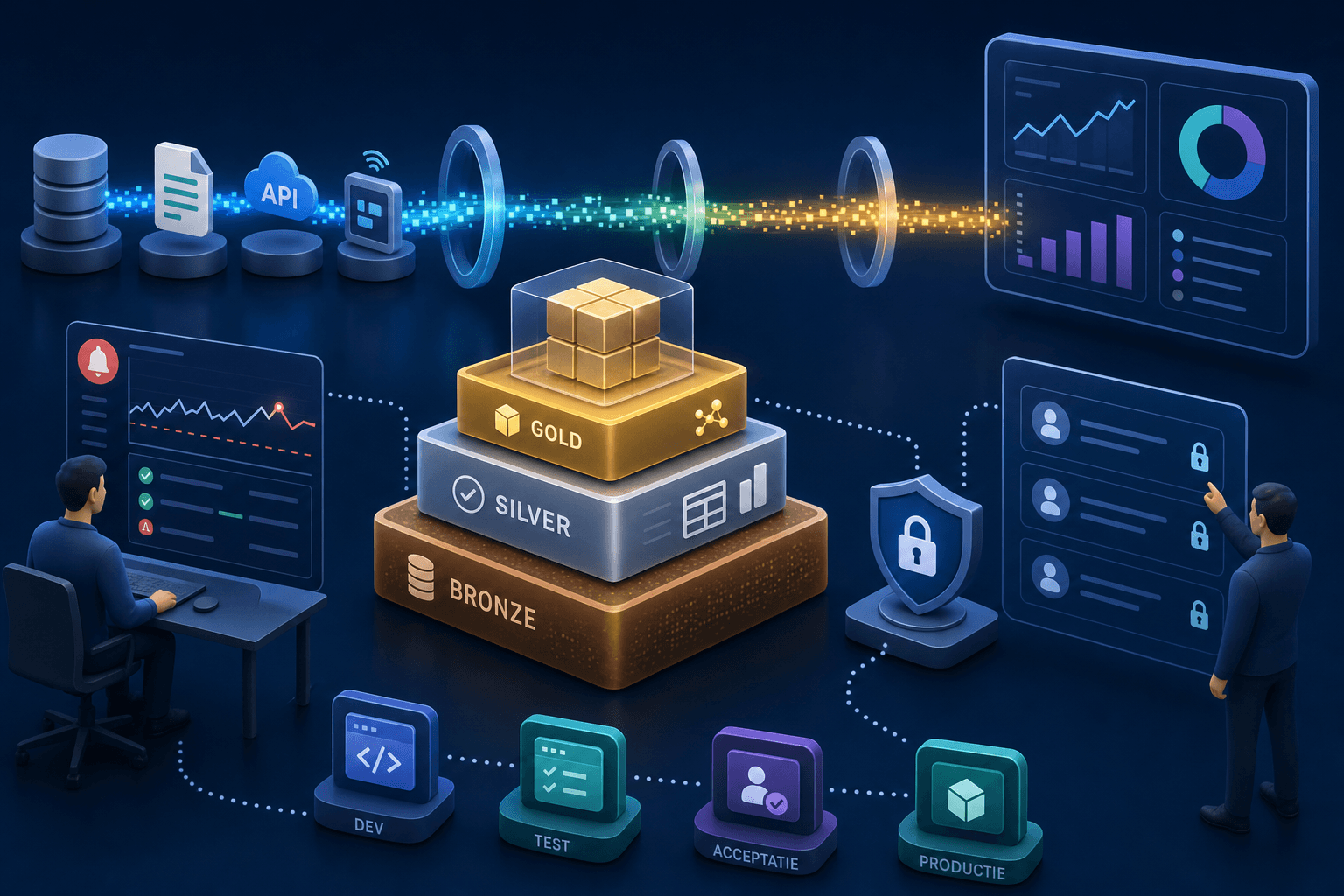
So make sure every data stream has a clear owner who is responsible for checking deviations. Set up validation rules on the Bronze and Silver layers (the raw and cleaned data layers in a medallion architecture) so deviations become visible early, not only in the final report.
AI works on what you have recorded
AI and BI (business intelligence, analysing data to support decisions) both depend on what is structurally recorded, not on what is theoretically available. AI does not work on what you have. AI works on what you have recorded.
A chatbot or autonomous workflow that makes decisions on shifted or incomplete data makes those decisions with the same confidence as when the data is correct. Garbage in, garbage out, except you do not see it immediately in a chart.
So set up dashboards and AI agents on the same Silver Layer, the layer with cleaned and standardised data. That way people and algorithms look at the same definitions, instead of two separate versions of the truth that slowly grow apart.
Governance and security from day one
Governance (the agreements and controls on who may view, change and share data) belongs at the start of a data stream, not as an addition afterwards. So set up row-level security (restricting data access at row level, per user or client) during the design.
Use DTAP environments (Development, Test, Acceptance, Production) so that a change is tested before it runs in production. That prevents an adjustment in one report from unintentionally affecting an entire chain.
Link access to Azure AD or SSO so that every employee, partner or client sees only what is relevant to their role. This is not legally required everywhere, but it is strongly advisable on subject-matter grounds once you share data with several parties.
Consistent definitions and the semantic layer
A figure is only useful when everyone uses the same definition. Without that agreement, one department calls someone an "active customer" if they ordered this month, while another calls anyone who was ever a customer that.
A semantic layer (a context layer that records what a term precisely means) solves this by naming one owner per term. Set this layer up on the Gold Layer, the layer where data is ready for reporting and AI.
Record this even more firmly for an AI layer than for a dashboard: in a chart you see a kink when a definition deviates, but in a sentence generated by an AI agent you do not see it.
Data management in practice for SMEs
For one food retail client, around 1,400 products and PLU codes were standardised and around 170 suppliers were connected centrally, with four DTAP environments in production. Without that standardisation, every supplier change would keep causing silent deviations.
For a marketing intelligence client, over 1 million visitor records and 11 KPIs were standardised within a multi-tenant environment with row-level security. Reports that used to take days now appear within minutes, because the underlying data is already checked and unambiguous.
Ongoing management and monitoring
Data management does not stop at delivery. Set up monitoring on data flows so that a stream that starts to drift is noticed early, not only when a report already deviates.
Extend the existing structure for each new question or new data source instead of starting over each time. The architecture under a thin stream is the same as under a broad platform: starting small is not wasteful, but the setup must keep management feasible in the long run.
Data management without an error message for deviations is not a small flaw, it is a gap in your foundation. With monitoring on data streams, clear definitions and governance from the start, data management remains the basis on which AI and BI run reliably. Not sure whether your data streams are already drifting? Book a Discovery Call and we will look at it together.