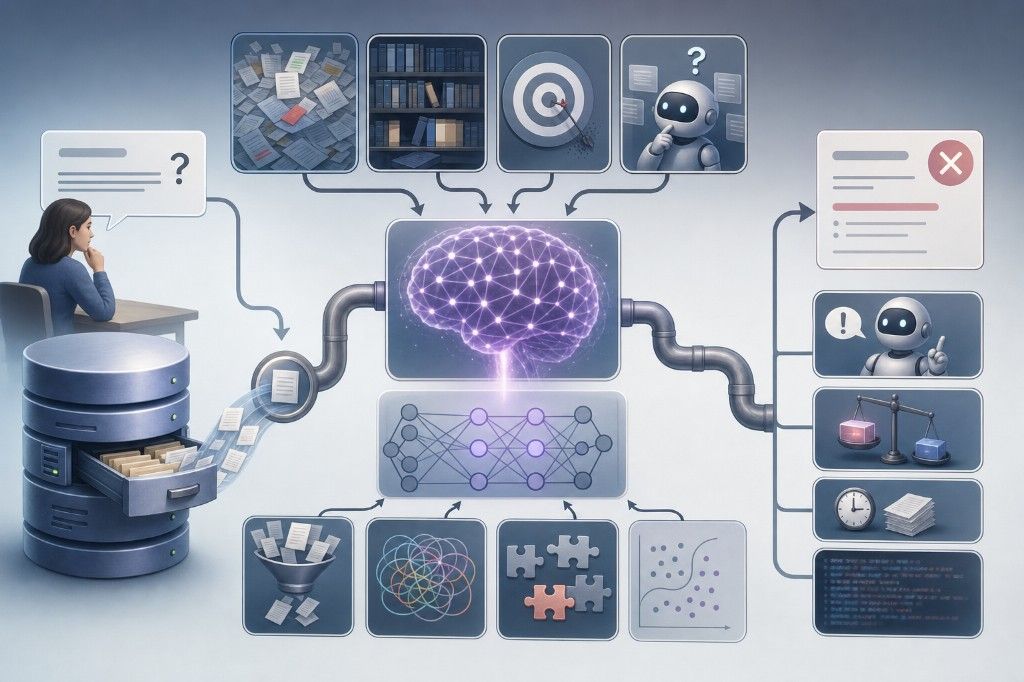
Your AI tool has full access to the database, yet it still gives a wrong answer or invents something that looks logical but isn't true. The problem is rarely the access itself. It sits in semantic context: the meaning layer that tells AI what a table, column, or KPI actually represents. Without that layer, a language model only sees raw fields, not business logic. At Impacture we see this with every client who wants to connect AI to existing data: the technology works, the meaning is missing.
What is semantic context and why is it crucial for AI?
Semantic context is the layer that records what data means, how concepts relate to each other, and who owns a definition. A column named "revenue" says nothing about whether it is gross or net, or over which period. AI fills that void itself, and that is exactly where a wrong answer originates.
In practice we see at clients that two departments define the same term differently. Sales counts an order as soon as it comes in, finance only after invoicing. An AI layer without semantic context picks one of the two at random, and nobody notices until the report doesn't add up.
Difference between semantic context and semantic SEO or analysis
Semantic context is about meaning in business data, not about search engine optimisation. Semantic SEO helps content better match search intent through related concepts. Semantic analysis in text processing extracts meaning from unstructured language.
Semantic context in a data platform is something else: it records semantic relationships (the links between concepts, such as "customer" and "order") in a model that both AI and people can consult. Where SEO and text analysis are about interpreting language, semantic context is about making business definitions unambiguous. Do not confuse the two when you scope an AI project, because the approach and the tools differ completely.
How embeddings and Knowledge Graphs create semantic context
Embeddings (mathematical representations of meaning) and a Knowledge Graph (a network of entities and their relationships) are the technical building blocks behind semantic context. Embeddings record that "customer", "buyer", and "client" refer to the same concept. A Knowledge Graph records how those concepts relate to each other, for example that a customer has multiple locations and each location has its own contracts.
Set this structure up before you let AI loose on your data. Link every table to an entity in the graph and give every KPI one owner. That way you prevent a chatbot from using two versions of "revenue" side by side without anyone noticing.
Semantic context as a remedy against AI hallucination
AI hallucination (an answer that sounds convincing but is factually incorrect) often arises because a model fills a meaning gap itself. Semantic context closes that gap: the model gets a fixed definition instead of room to guess.
This weighs more heavily with an AI layer than with a dashboard. In a chart you see a kink and go looking yourself. In a generated sentence you see nothing; the answer simply sounds plausible. If you want to give AI database access without the risk of silent errors, make sure every concept the model is asked about has one recorded meaning before you take the connection live.
Semantic context in Bronze, Silver and Gold layers
A medallion architecture (a layered build from raw to enriched data, divided into Bronze, Silver, and Gold) is where semantic context becomes practical. Bronze holds the raw, unfiltered data from source systems. Silver is where you standardise definitions and add context: here you determine what "revenue" or "customer" exactly means for the whole organisation.
Gold delivers the outcome, whether that is a report or an AI agent that independently answers a question. Messy data is work, and the conditions for a clean Silver layer are not a luxury. Set up the semantic layer at Silver level, so dashboards and AI agents consult the same definitions instead of each building their own interpretation.
Practical approach to semantic context in your data platform
Make sure every core concept has one owner who manages the definition and approves changes. Record who may access which data via row-level security (security that limits access to the rows that belong to a user), so semantic context does not accidentally expose sensitive information to the wrong user.
Test an AI layer first on a narrow data stream before you roll it out broadly. At CentreBlock, reporting went from days to minutes this way, with eleven KPIs that have the same meaning for everyone. Unsure whether your semantic layer is in order? Book a Discovery Call and we will tell you honestly.
An AI with full database access is only reliable once the meaning layer under that data is correct. Semantic context determines whether a model retrieves facts or guesses, and that difference shows up in every answer the organisation lets the model be trusted with. Without that layer, AI database access remains a risk rather than a result.